

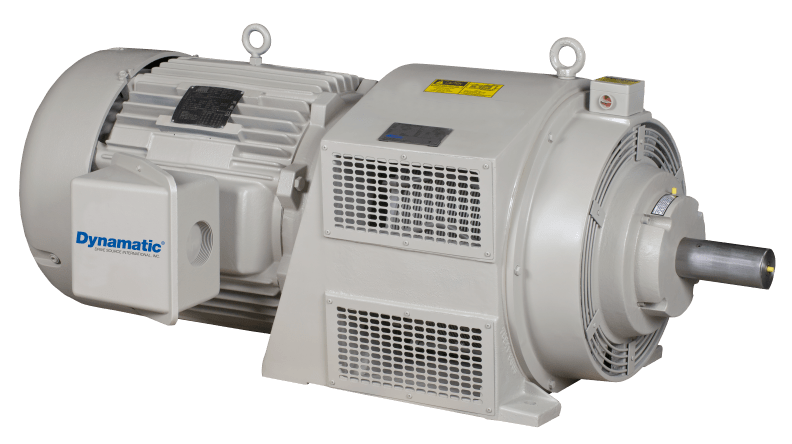
Adjustable-speed eddy current drives continue to prove their value in water and wastewater applications, offering a reliable and cost-effective alternative to variable frequency drives (VFDs). With decades of successful installations, Dynamatic Technologies has demonstrated that eddy current technology remains a strong contender where durability, simplicity, and long-term performance are critical.
Proven technology in demanding environments
Eddy current drive clutches coupled with induction motors have been widely used in water and wastewater treatment facilities for many years. Their robust design and inherent reliability make them particularly well suited to demanding industrial environments.
While VFDs gained traction from the 1980s onward, operational experience across global facilities has shown that eddy current systems can deliver what is often referred to as “true system efficiency”.
Defining true system efficiency
True system efficiency is not based solely on energy consumption. Instead, it considers three key cost factors:
- Capital investment
- Energy usage
- Total cost of ownership
In medium-voltage applications, eddy current drive systems can offer significant advantages across all three areas.
Lower capital and installation costs
Eddy current drives can reduce initial system costs by up to 65% compared to VFDs in medium-voltage applications. This is largely due to:
- No need for ancillary systems such as cooling or harmonic suppression
- Simpler installation and commissioning processes
- More compact electronic components, often 60–70% smaller than comparable VFD systems
These factors translate into faster deployment and lower upfront investment for municipalities and industrial operators.
Energy efficiency in real-world operation
In wastewater pumping applications, motors typically operate within a speed range of 75% to 100% of their rated capacity. Eddy current drives perform particularly efficiently within this range, with operating efficiency improving as speed increases.
By contrast, VFD efficiency tends to decline within this operating window and can be further impacted by the energy demands of supporting components such as cooling and filtering systems.
Additional benefits of eddy current drives include:
- Reduced peak demand costs due to smoother motor operation
- Capability to operate continuously in ambient temperatures of up to 40°C
- Lower overall energy consumption in typical pumping scenarios
Reduced maintenance and lifecycle costs
One of the most significant advantages of eddy current drives is their longevity. In many cases, these systems can last up to six times longer than comparable VFD installations.
Their rugged electromagnetic clutch design is highly tolerant of power quality fluctuations, reducing the risk of damage that often affects more sensitive electronic systems.
Maintenance is also straightforward, with:
- Simple mechanical components
- Easy servicing by on-site personnel
- Low-cost replacement parts
Unlike VFDs, eddy current systems generate minimal harmonic distortion, protecting both plant equipment and the wider electrical grid.
Minimising total cost of ownership
VFD systems are often associated with higher lifecycle costs due to:
- Faster product obsolescence
- Limited availability of replacement parts over time
- Increased complexity requiring specialised maintenance
In contrast, eddy current drives offer a stable, long-term solution with predictable maintenance requirements and extended service life.
Digital control for modern operations
To complement its drive systems, Dynamatic offers the EC-2000 digital control platform, designed for both new installations and retrofit applications.
The EC-2000 system provides:
- Simple and intuitive operation
- Programmable speed and run presets
- Compatibility with PLC and SCADA systems
- Local and remote control functionality
Importantly, the system does not require an external DC power supply, simplifying integration and reducing system complexity.
A practical solution for efficient pumping systems
As water and wastewater facilities continue to seek reliable and cost-effective drive solutions, eddy current technology remains a compelling option. By combining lower capital costs, strong operational efficiency, and reduced maintenance requirements, Dynamatic’s systems offer a balanced and practical approach to achieving long-term performance.
